
The 9 Types of Awnings, Compared
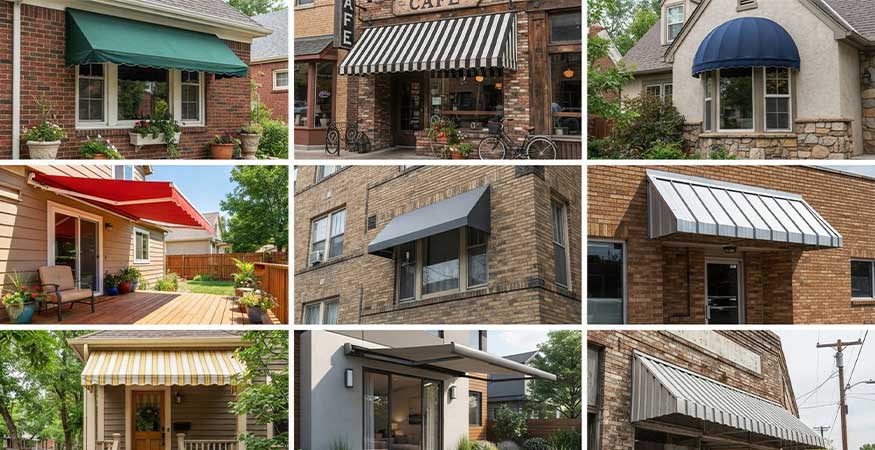
This guide compares nine awning types and provides four key questions to determine which style fits your building - covering location, purpose, sun exposure, and budget.
- Retractable awnings suit patios where owners want flexible shade, while fixed fabric and metal options work best for permanent cover on windows, doors, and storefronts.
- Pergola awnings handle large spaces like outdoor kitchens, freestanding units shade areas away from buildings, and drop shades block low western sun.
- Colorado's high altitude UV, winds, hail, and snow require specific materials like solution-dyed acrylic or metal, plus wind sensors on retractable models.
The main types of awnings include retractable awnings, stationary or fixed awnings, motorized awnings, freestanding awnings, window awnings, door awnings, patio awnings, pergola awnings, and dome awnings. Each type serves different purposes, from hand-cranked window shades to motorized 40-foot pergola roofs, with selection depending on your building's specific shading needs and installation requirements.
“Awning” covers everything from a hand-cranked window shade to a motorized 40-foot pergola roof, and picking the wrong type is the most expensive mistake in shading. Here are all nine types we install or get asked about, what each does best, and the four questions that sort out which one belongs on your building.
The four questions that pick your awning
- Where does it go? Patio and deck point to retractable or pergola types; windows and doors point to fixed or window awnings; open yard points to freestanding.
- What is the job? Afternoon shade, rain cover, energy savings, branding, or all-weather protection lead to different types.
- What is the sun exposure? West-facing takes the hardest afternoon load and rewards deep projection; south-facing rewards shade you can retract for winter sun.
- What is the budget? Honest ranges differ by an order of magnitude between a small fixed window awning and a large motorized system.
Hold your answers against the types below.
1. Retractable awnings
Fabric on spring-loaded arms that extends over a patio and rolls away on demand – the type most Denver homeowners end up choosing for main outdoor spaces. Shade when you want it, winter sun when you don’t, wind sensors to protect itself. The trade-offs and honest drawbacks are covered in our pros and cons piece.
Best for: patios and decks on homes whose owners want shade some of the time, not all of it.
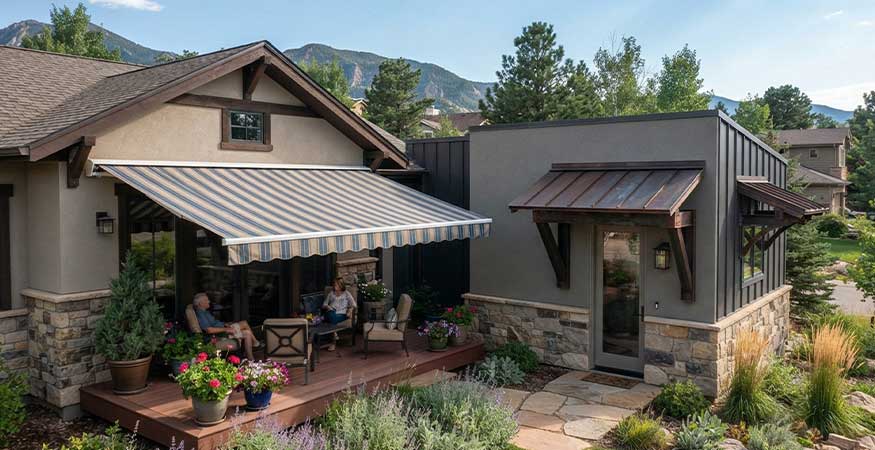
A cozy mountain retreat blends shaded outdoor living with landscaped charm. Striped awnings and blooming planters frame the inviting patio.
2. Fixed fabric awnings
Fabric stretched over a welded frame, permanently mounted. Constant shade, classic looks, lower cost than retractable at the same size – and no winter sun, plus fabric that faces the weather year-round. The full comparison is in retractable vs fixed.
Best for: windows, doors, storefronts, and patios that want permanent cover.
3. Metal awnings
Aluminum or steel, standing seam or louvered. Hail bounces off them, snow load is an engineering line item instead of a prohibition, and maintenance is a rinse. The cost is a fixed look and more radiated heat than fabric.
Best for: hail corridors, mountain properties, low-maintenance buyers. Details on our metal awnings page.
4. Window awnings
Small fixed or retractable awnings over individual windows – the highest energy return per dollar in shading, because they stop solar gain at the glass. Fabric or metal, sized to orientation. Our window awning walkthrough covers matching them to the house.
Best for: west- and south-facing windows, energy-first buyers, curb appeal.
5. Pergola awnings
A retractable fabric roof running in tracks over a pergola frame – overhead cover for spaces bigger than lateral-arm awnings can span, with posts carrying the load. Closes the gap between awning and roof.
Best for: large patios, outdoor kitchens and dining zones. See the pergola awnings page.
6. Freestanding awnings
Double-sided units on their own posts, no wall required. Shade for pools, spas, yard seating, or anywhere the house is not.
Best for: shading zones away from the building.
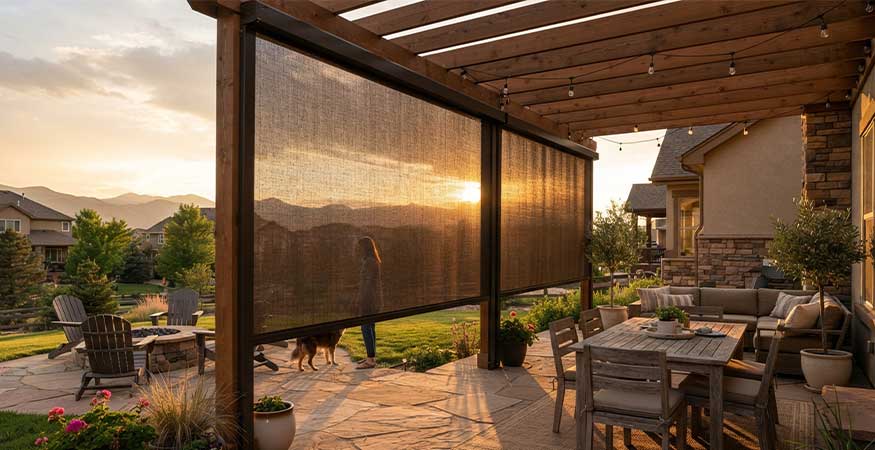
Golden sunset light transforms this covered patio into a cozy outdoor retreat. Dining, lounging, and mountain views come together beautifully.
7. Drop shades and vertical screens
Vertical fabric panels that lower from a housing – the answer to low western sun that slides under any overhead awning, and to wind on patio edges. Motorized versions close a covered patio into a usable room. More on the shades page.
Best for: west edges of patios, restaurant railings, screened enclosure duty.
8. Commercial and storefront awnings
Branded fixed awnings in printable vinyl or acrylic, doing signage, weather cover and energy work at once. Covered in depth on our commercial page.
Best for: storefronts, restaurants, offices.
9. Door and entrance awnings
Compact fixed units – fabric, metal or polycarbonate – that keep rain and sun off doorways and the people fumbling for keys under them.
Best for: entrances, service doors, walkways.
Quick comparison
| Type | Shade control | Weather rating | Relative cost | Upkeep |
|---|---|---|---|---|
| Retractable | On demand | Retracts to survive | $$$ | Seasonal |
| Fixed fabric | Constant | Rain yes, snow no | $$ | Seasonal |
| Metal | Constant | Rain, snow, hail | $$ | Minimal |
| Window | Constant | Matches material | $ | Low |
| Pergola | On demand | Retracts to survive | $$$$ | Seasonal |
| Freestanding | On demand | Retracts to survive | $$$ | Seasonal |
| Drop shades | On demand | Wind-rated by model | $$ | Low |
| Commercial | Constant | Matches material | $$–$$$ | Scheduled |
| Door | Constant | Matches material | $ | Low |
A Colorado note
Whatever the type, our altitude UV, chinook winds, hail and wet spring snow set the spec: solution-dyed acrylic or metal for longevity (the material comparison is here), wind sensors on anything retractable, and snow-load math on anything permanent (the ratings explainer is here). A type that thrives at sea level can be the wrong pick at 5,280 feet.
Recent Post
How to Clean Aluminum Awnings: Step-by-Step Guide to Remove Dirt, Stains, and Oxidation Without Causing Damage
Aluminum awnings protect your home from the sun, rain, and...
Retractable Awning Maintenance Tips: Expert Guide to Cleaning, Protecting, and Extending the Life of Your Awning
A retractable awning is a valuable investment that adds shade,...
20 Deck Awning Ideas Perfect for Patio Season: Stylish Shade Solutions to Elevate Outdoor Comfort, Design, and Functionality
Deck awnings are one of the most effective upgrades for...
Can Retractable Awnings Be Installed on Vinyl Siding? Expert Guide to Safe Installation, Structural Support, and Best Practices
Retractable awnings can be installed on homes with vinyl siding,...


