
Choosing the Best Window Awnings for Your Denver Home | Style, Function & Curb Appeal
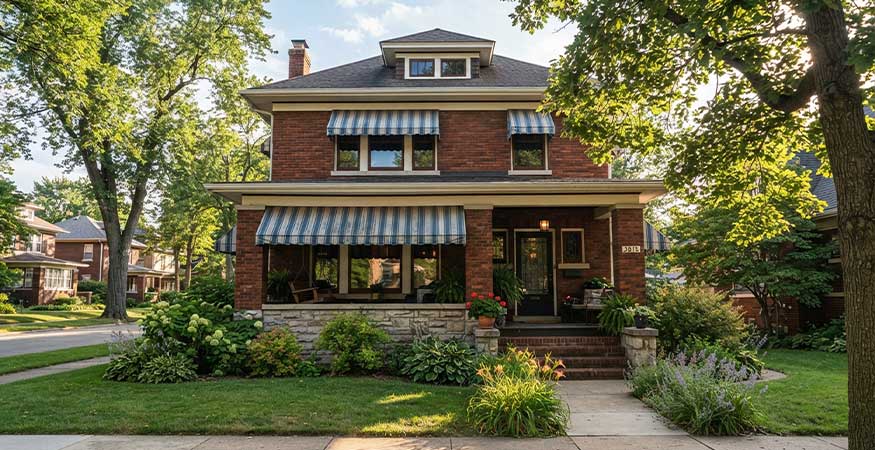
Window awnings are essential for Denver homes, offering protection from harsh weather while enhancing energy efficiency and curb appeal. Selecting the right style and material can significantly improve indoor comfort and outdoor aesthetics.
- Awnings provide shade, reduce heat gain, and lower cooling costs during summer months. They also protect windows from rain and snow, enhancing durability.
- Options include retractable awnings for flexibility, aluminum for durability, and eco-friendly materials for sustainability.
- Choosing the right design and color can complement your home's architecture, creating a visually appealing outdoor space.
Window awnings offer several advantages for Denver homes, including protection from the intense sun and unpredictable weather. They enhance energy efficiency by reducing heat gain, which can lower cooling costs during summer months, while also shielding windows from rain and snow, contributing to overall home comfort.
Window awnings are the quiet workhorse of home shading – less glamorous than a big patio retractable, but dollar for dollar the most effective energy upgrade on this site. Shading west glass before sun hits it beats any interior blind, and at Denver’s altitude – where UV runs about 25 percent stronger than sea level – the fade protection for floors and furniture is not subtle either. Here is how to choose well.
What window awnings actually do
- Cut cooling costs: blocking solar gain at the glass is the efficient point of interception – shaded-window studies cited by ASHRAE show cooling-cost reductions up to 25 percent, and window awnings are the purest version of the principle.
- Block up to 98 percent of UV before it reaches interiors – the difference visible in five-year-old hardwood floors with and without shading.
- Reduce heat without losing light: rooms stay bright and views stay open, unlike closed blinds. (More in our window awnings and heat guide.)
- Add curb appeal and value: matched awnings across a facade read as architecture, not accessory – and buyers notice usable, sun-managed rooms. They serve homes and businesses alike – storefront window awnings do the same energy work while carrying brand colors.
Fabric or metal?
Fabric window awnings offer the traditional silhouette, hundreds of colors, and the breathability that keeps trapped heat from radiating at the glass. Solution-dyed acrylic is the fabric to insist on here (why, in our materials guide).
Metal (aluminum) window awnings are the set-and-forget option: hail-proof for practical purposes, zero fabric maintenance, decades of life. The trade-offs are a fixed look and more radiated heat. In hail corridors, metal window awnings are often the rational choice – searchers asking for “metal window awnings near me” are usually asking post-hailstorm.
Eco note: if sustainability matters, solution-dyed acrylic’s longevity is the green feature, and recycled-content and PVC-free options exist for larger projects.
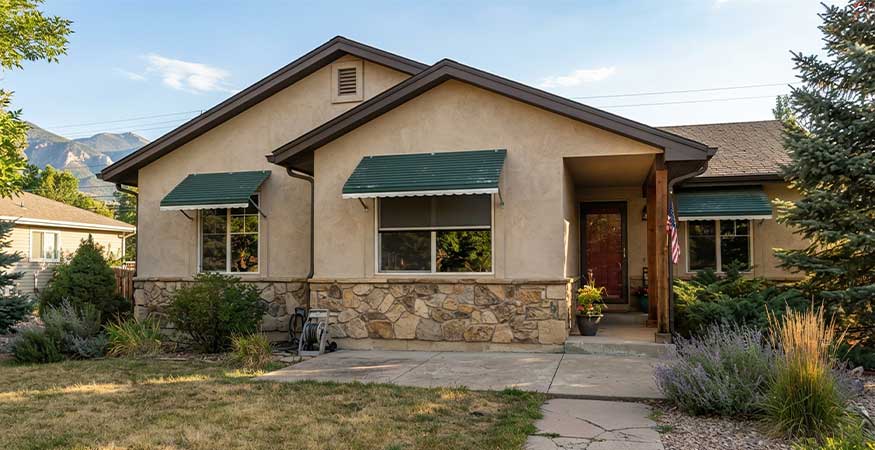
A welcoming single-story home framed by mature landscaping and mountain views.
Fixed or retractable?
Most window awnings are fixed – windows want constant shading, and fixed units are cheaper and stormproof-er. Retractable window awnings earn their premium on south-facing windows where you want winter solar gain, and on view windows where seasonal flexibility matters. A practical Denver pattern: fixed on west windows, retractable or none on south.
Matching awnings to your home’s architecture
The awning should look inherited, not installed. Traditional homes (bungalows, Tudors, Victorians) carry classic sloped fabric awnings with valances naturally – often in period stripes. Modern homes want clean-lined, valance-free profiles or crisp metal. Two rules that never miss: match or complement the trim color rather than the field color, and keep every street-facing awning the same style and color. If your neighborhood has an HOA, check approval requirements before ordering – color restrictions are common and approval is usually straightforward.
Sizing and placement
Correct projection depends on window height and orientation: west windows want deeper coverage (low afternoon sun comes in nearly horizontal), south windows want a projection calibrated to block high summer sun while admitting low winter sun – the classic passive-solar geometry. This is exactly what an on-site measurement is for; it is also why phone-quoted window awnings so often disappoint.
Installation: DIY or professional?
Window awnings are the most DIY-plausible awning type – small, light, no springs. The honest line: a single small fabric awning over a ground-floor window is within a capable DIYer’s reach if it anchors into framing. Professional installation earns its cost on anything second-story, anything metal, multi-window matching runs, and any wall where finding structure is not obvious (stucco over frame, brick veneer). We install both, and re-cover existing window awnings whose frames are sound.
Window awnings measured, matched and installed across Denver and the foothills since 1979 – Best Awning Company, 303‑816‑2303.
Recent Post
How to Clean Aluminum Awnings: Step-by-Step Guide to Remove Dirt, Stains, and Oxidation Without Causing Damage
Aluminum awnings protect your home from the sun, rain, and...
Retractable Awning Maintenance Tips: Expert Guide to Cleaning, Protecting, and Extending the Life of Your Awning
A retractable awning is a valuable investment that adds shade,...
20 Deck Awning Ideas Perfect for Patio Season: Stylish Shade Solutions to Elevate Outdoor Comfort, Design, and Functionality
Deck awnings are one of the most effective upgrades for...
Can Retractable Awnings Be Installed on Vinyl Siding? Expert Guide to Safe Installation, Structural Support, and Best Practices
Retractable awnings can be installed on homes with vinyl siding,...


