
The Pros and Cons of Retractable Awnings: An Honest Assessment

We have installed retractable awnings across the Denver metro since 1979 and share an honest assessment of their benefits and drawbacks to help homeowners decide if one is right for them.
- Retractable awnings mount to walls without posts, extend 8 to 13 feet, and can be manual or motorized with wind sensors. They provide shade on demand - up to 20 degrees cooler - while preserving winter sun and mountain views.
- Quality motorized units are a four-figure investment, and wind is the main enemy. Colorado sites need wind sensors as standard equipment, and awnings must never be extended under snow.
- If your patio bakes in afternoon sun and you buy a quality unit with a wind sensor, it is one of the highest-use-per-dollar upgrades. If your site has sustained winds or you need year-round cover, a fixed structure is better.
Retractable awnings offer several benefits including adjustable shade control, protection from UV rays, reduced cooling costs, and the ability to retract during bad weather or winter months. However, drawbacks include higher costs compared to fixed awnings, mechanical parts that can wear out over time, wind sensitivity requiring retraction during storms, and regular maintenance needs to keep the fabric and mechanisms functioning properly.
We have installed retractable awnings across the Denver metro since 1979, and we will tell you up front: they are not for everyone. This guide covers how they actually work, the genuine advantages, and the drawbacks that awning websites usually bury – so you can decide whether one belongs on your house.
How do retractable awnings work?
A retractable awning mounts to the wall or roof and extends fabric over your patio on spring-loaded lateral arms – no posts, no footings. The arms fold like elbows as the fabric rolls onto a tube at the wall, so the whole assembly disappears into a hood or cassette when closed. Typical projections run 8 to 13 feet, with widths to 40 feet in joined units.
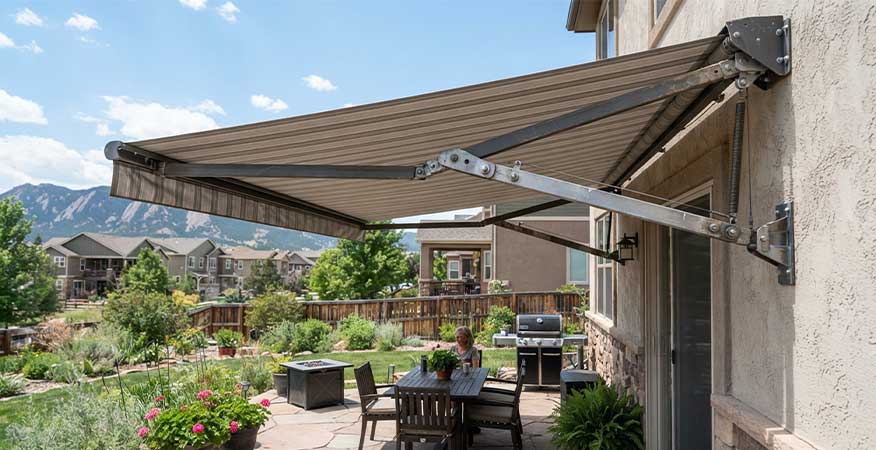
You operate one three ways: a hand crank (manual), a motor with a remote or wall switch, or a motor plus sensors that extend and retract it automatically with sun, wind and motion. In Colorado we push hard for the motorized-with-wind-sensor option, for reasons covered under the cons.
Do they work? Yes – the mechanism is mature, century-old technology refined with modern motors. Whether one is right for you comes down to the trade-offs below.
The pros
- Shade on demand – up to 20 degrees cooler. Extend it at 2 p.m., retract it for evening sky. A west-facing patio becomes usable all afternoon.
- You keep winter sun. Unlike a fixed cover, a retracted awning lets low winter sun warm the house – and preserves your view of the Rockies year-round.
- Lower cooling costs. Shading glass doors and windows cuts solar gain; shaded-glazing studies cited by ASHRAE show cooling-cost reductions up to 25 percent.
- No posts, no permits in most cases. Wall-mounted retractables usually avoid the footings, posts and (often) the permit process a pergola or fixed roof requires – check our Colorado permit guide for the exceptions.
- Privacy, when you want it. Extended, an awning screens an overlooked patio from second-story sightlines next door – then disappears when you would rather have open sky.
- UV and furnishings protection. Quality fabrics block up to 98 percent of UV, protecting people on the patio and the floors and furniture behind the glass.
- Automation that protects itself. Sun, wind and motion sensors mean the awning manages Colorado’s fast weather even when you are not home.
- Fabric is renewable. After a decade, replace the fabric alone – fresh awning, half the cost, same frame.
The cons – the honest part
- Cost. A quality motorized retractable is a four-figure purchase, and premium large-span systems go well beyond that. Cheap ones exist; in our wind and UV they do not last, and we decline to install them.
- Wind is the enemy. Retractables are engineered to retract before wind, not endure it. Gusty foothills sites need a wind sensor as standard equipment and, on exposed lots, a frame with a higher wind class – or a different product entirely. See our wind and snow ratings guide.
- No snow. Ever. A retractable extended under Colorado snow is a broken retractable. If you want overhead cover that stands through winter, you want a fixed or metal structure instead.
- HOA approval. Many Front Range HOAs require approval for awnings – usually granted, but factor in the timeline and color restrictions before ordering.
Who should skip a retractable
Be cautious if: your site takes sustained ridge-line winds; you want cover that stays up year-round; or the budget only stretches to a bargain-grade unit. In those cases a fixed metal awning, a pergola system, or simply high-quality shades will serve you better – we sell all three, so our recommendation is not tied to one answer.
A note on DIY installation
A 20-foot retractable awning typically weighs 150 to 350 pounds, carries loaded springs, and must anchor into structure – not just siding – to survive its first gusty afternoon. This is one of the few home projects we genuinely discourage as DIY; an awning that pulls out of a wall is a safety issue, not just a warranty claim. (More in our DIY-versus-professional guide.)
So – are retractable awnings worth it?
If your patio bakes in afternoon sun, you value winter light and views, and you buy a quality unit with a wind sensor: yes, it is one of the highest-use-per-dollar upgrades a Colorado home can get. If your site or expectations match the cons above, put the money into a fixed structure instead. Either way, the free way to find out is an on-site assessment – exposure and mounting usually make the decision for you.
Free on-site assessments across Denver and the foothills since 1979 – Best Awning Company, 303-816-2303.
Recent Post
20 Deck Awning Ideas Perfect for Patio Season: Stylish Shade Solutions to Elevate Outdoor Comfort, Design, and Functionality
Deck awnings are one of the most effective upgrades for...
Can Retractable Awnings Be Installed on Vinyl Siding? Expert Guide to Safe Installation, Structural Support, and Best Practices
Retractable awnings can be installed on homes with vinyl siding,...
The Right Way to Install a Door Awning: Expert Guide for Durable Protection, Style, and Weather Resistance
A properly designed door awning is more than just an...
Is Your Awning Ready for Summer? Essential Guide to Inspection, Maintenance, and Long-Lasting Protection
Summer heat, stronger UV rays, and changing weather conditions can...


